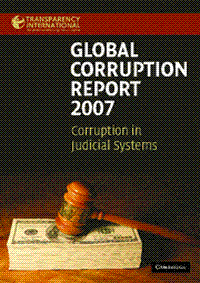
The Global Corruption Report 27 looks at how, why and where corruption mars judicial processes, and to reflect on remedies for corruption-tainted systems. The book focuses on judges and courts but situates them within the broader justice system - police, prosecutors, lawyers and agencies responsible for enforcing judicial decisions. It also looks at the social context of the judiciary and shows how societal expectations, the existence of non-state justice mechanisms and the strength of informal networks that circumvent the justice system, all have a bearing on judicial corruption. The book takes a close look at the two main judicial corruption problems: political interference and petty bribery by court personnel. The 37 country case studies and a series of concrete recommendations for judges, political powers, businesses, lawyers, prosecutors, academics, NGOs and donors are supplemented by 15 empirical studies of corruption in various sectors, including the justice sector. Contents
Part I. Comparative Analysis of Judicial Corruption: 1. Introducing the problem Mary Noel Pepys, Transparency International 2. Independence, political interference and corruption Susan Rose-Ackerman, Stefan Voigt, Roy A. Schotland, Tom Blass and Gugulethu Moyo 3. Accountability and competence of judges Greg Mayne, Emilio Crdenas, Hctor Chayer, Vincent Yang, Linda Ehrichs, Carlo Guarnieri, Zora Ledergerber, Gretta Fenner and Mark Pieth, 4. The broader justice system Edgardo Buscaglia, Nicholas Cowdery, Eva Joly, Jorge Fernndez Menndez, Fiona Darroch, Don Deya and Arnold Tsunga 5. Courts, culture and corruption Marina Kurkchiyan Gherardo Colombo, Geoffrey Robertson, Katya Salazar, Jacqueline de Gramont, Celestine Nyamu-Musembi and Stephen Golub 6. Lessons learned about fighting judicial corruption Linn Hammergren, Oluyemi Osinbajo, Keith Henderson, Fabrizio Sarrica and Oliver Stolpe Part II. Country Reports on Judicial Corruption: 7. Country reports on judicial corruption Transparency International, Fayal Mtaoui, Rena Safaralieva, S. I. Laskar, Samantha Ford, Theary C. Seng, Davor Harasic, Roxana Salazar, Jos Pablo Ramos, TI Croatia, Michal tika, Hossam Baghat, Tamuna Karosanidze, Camrin Christensen, Dominic Ayine, Mechthild Ruenger, Daniel Batidam, Carlos Melgar Pea, Transparency International India, Doron Navot, Transparency International Kenya, Miguel Carbonell, Transparency International Mongolia, Transparency Maroc, Krishna Prasad Bhandari, Djibo Abdoulaye, Jawaid A. Siddiqi, Palestine Coalition for Accountability and Integrity, Anglica Maytn Justiniani, Transparency Paraguay, Dolores Espaol, Transparency International Papua New Guinea, Victor Alistar, Judith February, Kishali Pinto Jayawardana, J.C. Weliamuna, Transparency International Turkey, Kyela Leakey, Davies Chikalanga, Goodwell Lungu and Ngoza Yezi Part III. Corruption Research: 8. Introduction Robin Hodess 9. When are judges likely to be corrupt? Stefan Voigt 1. Bribes, punishment and judicial immunity Ernesto Dal B, Pedro Dal B and Rafael Di Tella 11. Informality, legal institutions and social norms se Berit Grdeland 12. Enforcement of anti-corruption laws: the need for performance monitoring Tiernan Mennen, Eric Fry and, Richard E. Messick 13. The global corruption barometer 26 Tom Lavers 14. Measuring corruption - myths and realities Daniel Kaufmann, Aart Kraay and Massimo Mastruzzi 15. Corruption perceptions index 26 Johann Graf Lambsdorff 16. Bribe payers index (BPI) 26 Diane Mak 17. International business attitudes to corruption John Bray 18. Business corruption - speak out or take part? Tina Sreide 19. Specific manifestations of corruption: comparing Brazil and Russia Leon Zurawicki 2. Explaining patterns of corruption in the Russian regions Phyllis Dininio and Robert Orttung 21. Quantifying public procurement losses in the Czech Republic David Ondrcka 22. Identifying reticent respondents in Romanian corruption surveys Omar Azfar and Peter Murrell 23. ANCORAGE-NET - sharing knowledge-based solutions to corruption control Lus de Sousa and Joo Tries 24. Auditing, accountability and anticorruption - how relevant are autonomous audit agencies? Carlos Santiso.


 Home > LAWYERS > Property Law > General Interest > Society, Politics and Philosophy > General >


 5
5


![The Practical Lawyer - PLW [Annual Subscription]](https://s3.amazonaws.com/ebcwebstoretest/images/12.jpg)